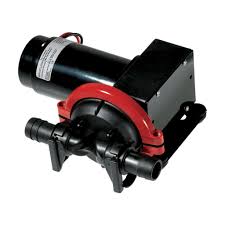
Description
The Johnson Pump Low Boy is an ultra-low-profile submersible bilge pump designed to mount in shallow, tight bilges and to strip water down to a low residual where a conventional upright pump leaves standing water — or simply won’t fit. Available in 2,840 / 4,380 LPH (750 / 1250 GPH), 12 V DC, with a water-cooled motor for long service life and a low-profile body that lifts out easily for cleaning.
Performance
| Model | Flow (open) | Current | Fuse | Port |
|---|---|---|---|---|
| Low Boy 750 | 2,840 LPH (750 GPH) | 3 A | 5 A | 3⁄4″ Dura-Port |
| Low Boy 1250 | 4,380 LPH (1250 GPH) | per data sheet | per data sheet | 1⅛″ hose |
Choosing the right capacity
Bilge-pump ratings are open-flow figures (ISO 8849 / ABYC H-22); installed output is always lower once you add static head, hose length, elbows and a check valve. Size for the volume of nuisance water you expect, with margin — the Low Boy’s strength is low-profile stripping, not high-head lift, so keep the discharge run short and as straight as possible.
Where the Low Boy fits
Its ultra-low profile makes it the natural stripping pump — the last pump that takes a flat or shallow bilge down to almost dry, working alongside a higher-capacity primary that shifts the bulk of the water. It also suits shallow lockers, sole bilges and tight compartments where height is limited.
Nuisance water, not damage control
The Low Boy is a compact intermittent-duty pump for rain, spray, shaft-gland weep and washdown — not a means of dewatering a holed hull. Emergency dewatering is the job of a dedicated engine-driven or portable crash pump, and on commercial and survey vessels it falls under AMSA / NSCV bilge-pumping requirements. Fit the Low Boy as one layer of the bilge system, and control it with a float switch or panel (it is a non-automatic pump).
Key features
- Ultra-low profile — mounts and strips water in shallow, tight bilges
- 2,840 / 4,380 LPH (750 / 1250 GPH), 12 V DC
- Water-cooled motor for extended service intervals
- Dura-Port discharge (750); 1⅛″ hose (1250)
- Low-profile body — lifts out for quick cleaning
- Non-automatic — pair with a float switch or panel
MARPOL & oily-water discharge
A bilge pump discharges whatever is in the bilge overboard, so oily-water law applies. Under MARPOL Annex I — given effect in Australia by the Protection of the Sea (Prevention of Pollution from Ships) Act 1983 and enforced by AMSA — it is an offence to discharge bilge water containing oil above the permitted limit. Larger vessels must pass machinery-space bilge water through an approved oily-water separator to below 15 ppm and never discharge in a port or a special area; smaller craft without a separator must hold oily bilge water and land it ashore. A visible oil or diesel sheen means overboard discharge is illegal — keep the bilge clean and oil-free and route to a holding tank or separator where contamination is possible. This matters most with automatic pumps, which can discharge unattended.
Test it monthly
A bilge pump that fails quietly is only found when it is finally needed. Test every bilge pump and its switch or sensor at least monthly: raise the water level or trigger the float/sensor, confirm the pump runs and moves water, and check that the strainer basket is clear, the check valve seats, and the discharge runs freely with no air lock. Confirm any automatic model cuts in and out on its own, and keep a spare strainer basket and service kit aboard.
Dealer notes
- This is a stripping pump — run it alongside a higher-capacity primary; the Low Boy takes a shallow or flat bilge down to near-dry.
- Its strength is low profile, not head — keep the discharge run short and straight.
- Non-automatic — add a float switch or panel. Water-cooled motor — don’t run dry; test monthly.
Do not run dry. The water-cooled motor relies on the water it pumps for cooling — extended dry running will overheat and damage it.
Johnson Pump Marine by SPX FLOW. Supplied by Y3 Marine. Open-flow ratings (ISO 8849); confirm current draw and fusing against the Johnson data sheet for the model.