
Description
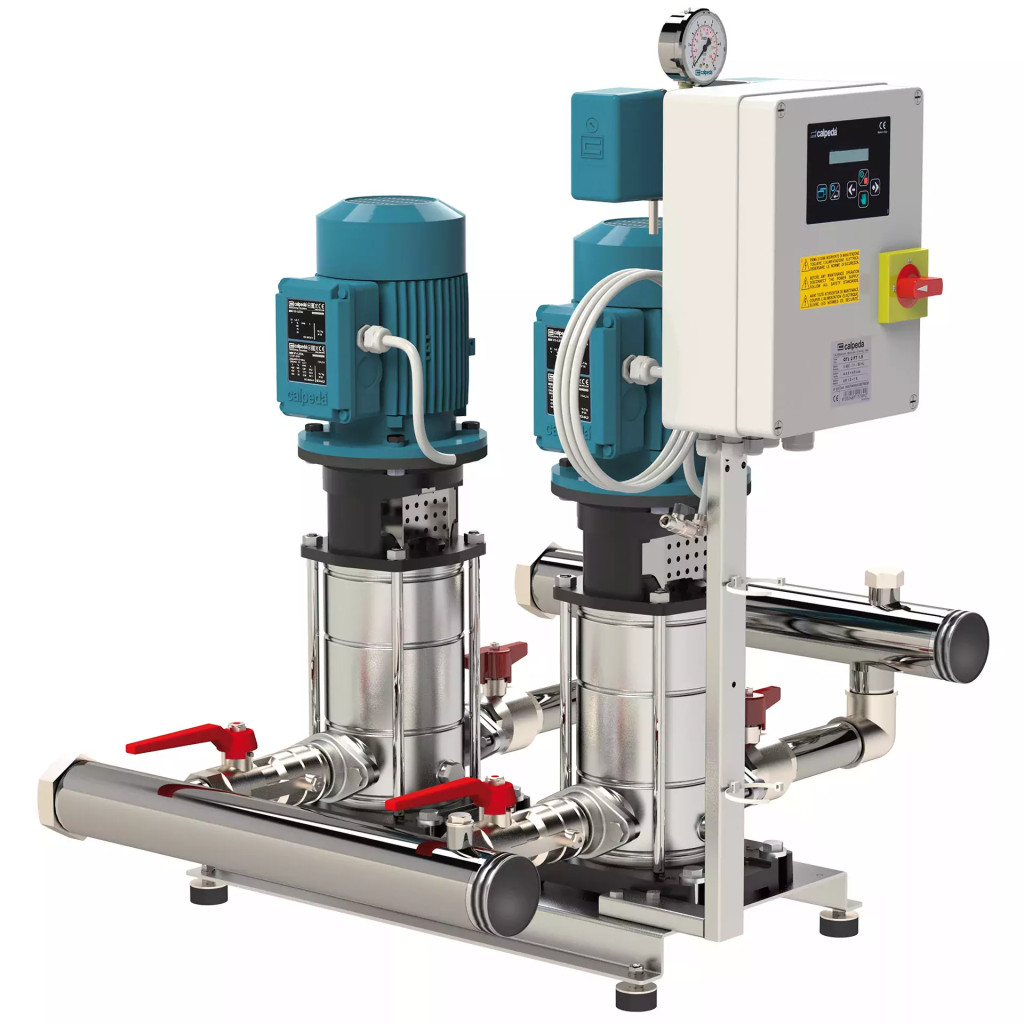
The Calpeda BS.MXV booster set is a multi-pump freshwater pressure station built around the MXV vertical multi-stage pump — one- or two-pump configurations for larger yacht, fire and commercial freshwater systems.
Calpeda BS.MXV Booster Set — Calpeda BS.MXV — Multi-Pump Pressure Boosting Station
The BS.MXV is Calpeda’s multi-pump booster set, built around the MXV vertical multi-stage in-line pump series. Where the MÈTA is a plug-and-play single-phase solution for smaller vessels, the BS.MXV is an engineered, multi-pump system for vessels needing three-phase power, duty/standby redundancy, higher flow, or elevated liquid temperatures. On a yacht it is normally configured as a compact 1- or 2-pump set; the larger multi-pump arrangements serve commercial vessels and firefighting mains.
Yacht Selection — Start Here
Domestic freshwater demand on a yacht is typically 2–8 m³/h at 4–6 bar, even on a 60–70 m vessel with ten or more cabins. The right BS.MXV for a yacht is therefore a 1- or 2-pump set (duty plus standby) built on an MXV 25, 32 or 40, with only enough stages to deliver the required pressure. The larger 3–6 pump configurations and the full 150 m³/h capability are commercial-vessel, firefighting and shore-scale builds — available on request, but not what a yacht domestic system needs.
System Configurations
- BS 1–3F (Fixed Speed): 1 to 3 fixed-speed MXV pumps as standard (4 to 6 on request), starting in cascade sequence via pressure switches. Microprocessor control panel with pump alternation, anti-water-hammer delay, air-cushion monitoring in pressure vessel, and optional RA 100 remote alarm. Motor starting direct on line up to 5.5 kW; star-delta from 7.5 kW.
- BS 2–3V with I-MAT (Variable Speed): 2 or 3 pumps, all running at variable speed via I-MAT frequency converter. Constant pressure mode maintains setpoint regardless of demand. Proportional pressure and constant temperature modes also available. Up to 6 variable-speed + 5 fixed-speed pumps can be cascaded in one system.
- BS 2V with WALL (Variable Speed): 2 variable-speed pumps with WALL frequency converter. Constant or fixed-speed operating modes. Suitable where a simpler VFD interface is preferred.
Pump Options — MXV vs MXVL
- MXV (standard): AISI 304 wetted internals; cast iron outer casing for DN65 and above. Suitable for freshwater, HVAC chilled water, hot water distribution up to 90°C.
- MXVL (316L option): Full AISI 316L stainless construction including outer casing. Higher corrosion resistance for aggressive treated water, desalinated water, or installations requiring 316L certification.
Which Vessel Is This For?
The BS.MXV is the correct choice when one or more of the following applies:
- The vessel has a three-phase 400 V electrical system (typical on yachts 40 m+)
- Flow demand exceeds 14 m³/h (the maximum of the single-phase MÈTA twin set)
- Liquid temperature exceeds 35°C (MXV is rated to 90°C standard, 110°C on request)
- More than two pumps are needed for redundancy (N+1 or N+2 on larger vessels)
- The system must integrate into a BMS or SCADA via Modbus (I-MAT option)
Key Specifications by Pump Model
| Pump Model | Max Flow (per pump) | Max Head | Motor Power | Connection |
|---|---|---|---|---|
| MXV 25 | ~3 m³/h | 228 m | 0.75–3 kW | 1″ BSPP |
| MXV 32 | ~8 m³/h | 205 m | 1.1–4 kW | 1¼” BSPP |
| MXV 40 | ~14 m³/h | 226 m | 1.5–7.5 kW | 1½” BSPP |
| MXV 50 (on request — fire/commercial) | ~20 m³/h | 267 m | 1.1–18.5 kW | 2″ BSPP |
Max head figures are the tallest stage-stack builds (up to ~27 bar), intended for firefighting, reverse-osmosis feed and commercial duty. A yacht domestic set uses the same flow size with far fewer stages to deliver ~4–6 bar — contact Y3 Marine for the correct stage count for your pressure.
- Pumps: 1 to 3 standard (4–6 on request)
- Voltage: Three-phase 230/400 V up to 3 kW; three-phase 400/690 V from 4 kW
- Manifolds (2 and 3-pump units): AISI 304 stainless steel suction and delivery
- Liquid temperature: −15°C to +90°C standard (EPDM seals)
- Motor protection: IP55
Duty Cycle
All MXV motors in the BS.MXV are rated for continuous duty (S1) — the motors can run at full load indefinitely without overheating, making the BS.MXV suitable for constant pressurisation of vessel freshwater systems around the clock. The microprocessor control alternates pump starting across units to equalise run hours and wear. Fixed-speed units start direct-on-line up to 5.5 kW and star-delta from 7.5 kW.
The BS.MXV is a configured-to-order product. Contact Y3 Marine with your flow rate, head, voltage, number of pumps, and liquid temperature requirements for a quotation and pump selection.
Note: MXV 25, MXV 32 and MXV 40 are the standard yacht domestic configurations. The MXV 50 — and the larger MXV 65, MXV 80 and beyond — are high-flow, firefighting and commercial-vessel builds, supplied on request. Contact Y3 Marine to discuss requirements.
Pressure Vessel
A diaphragm pressure vessel or galvanised tank must be connected to the delivery manifold (G1 provision point supplied). Variable-speed units require only a small membrane vessel (20 L is typically sufficient). Fixed-speed units require a larger traditional vessel sized to the system — recommended sizes are stated per model in the Calpeda selection tables.
As a guide for fixed-speed sets, size the vessel so its usable drawdown is roughly 25% of one pump’s per-minute flow — this holds motor starts to about 15–20 per hour; with a typical cut-in/cut-out band the nominal tank is several times that drawdown. Confirm against the Calpeda selection tables and the pump’s maximum starts per hour.
Installation Note
The BS.MXV uses MXV vertical multi-stage pumps which are not self-priming. A flooded suction is required — the water source must be at or above the pump inlet level. Ensure adequate NPSH is available at the suction port for the selected pump model.
Engineering & Selection Notes
- NPSH / cavitation: not self-priming — keep the NPSH available at the inlet at least 0.5 m above the pump’s NPSH required (Calpeda curve). NPSHa = atmospheric + static suction head − vapour pressure − suction losses (m of liquid); hot-liquid duty raises vapour pressure and needs extra margin. Y3 Marine confirms NPSHr for your model.
- Reading the table: max flow and max head are curve endpoints — max flow occurs near zero head and max head near zero flow. The real duty sits on the curve between them, ideally near the best-efficiency point; Y3 Marine selects to your duty point.
- Engine-room ambient: motor ratings assume ≤40 °C ambient; engine rooms often run hotter, so above 40 °C de-rate the motor or step up a frame size to avoid thermal overload.
- Generator starting: direct-on-line start draws ~6–8× full-load current — on larger three-phase motors use star-delta, soft-start or a VSD and check inrush against available generator capacity.
- Minimum flow: multistage pumps overheat if run against a closed valve (dead-headed) — fit a minimum-flow bypass or thermal protection on circuits that may run with all outlets shut.