
Description
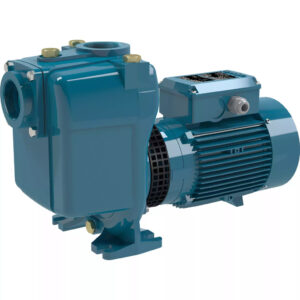
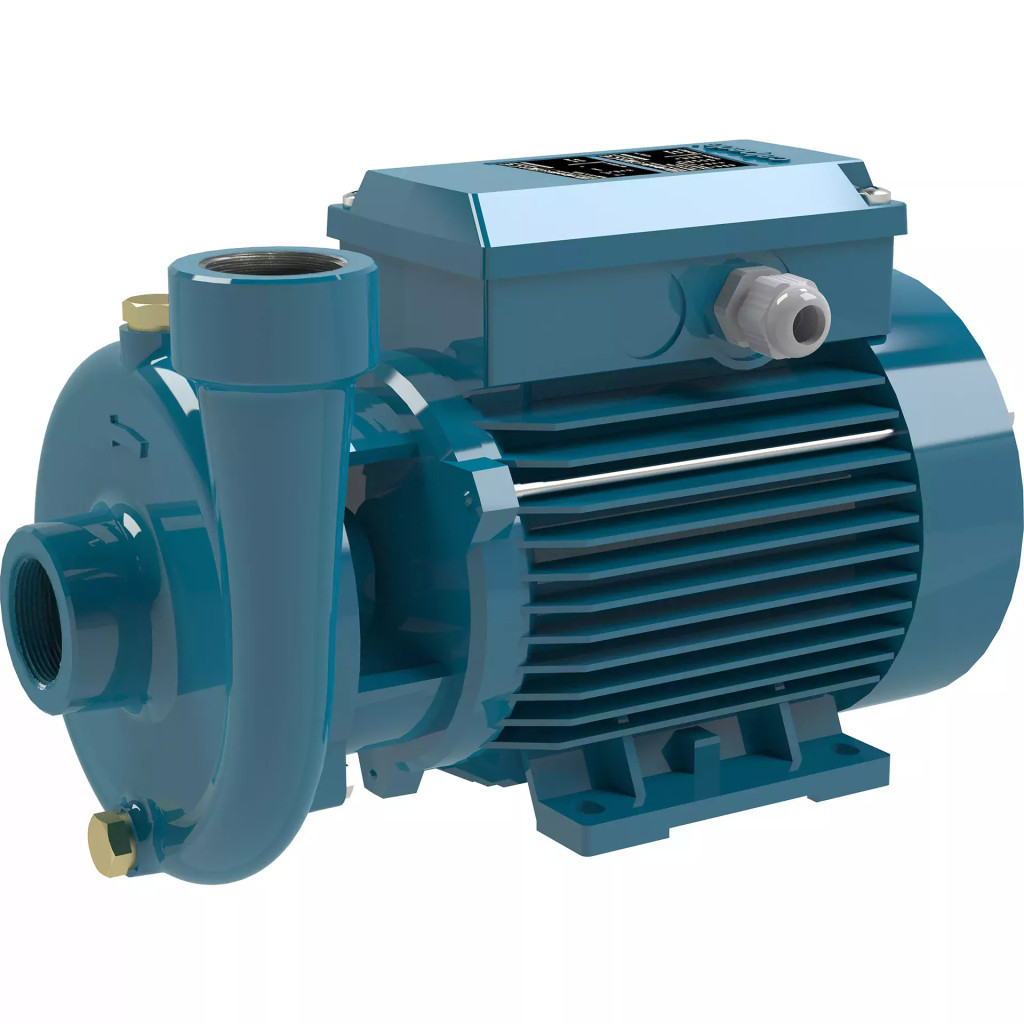
The Calpeda BC centrifugal pump is a bronze close-coupled pump for seawater cooling, glycol loops and engine jacket-water circuits aboard superyachts — corrosion-resistant, rated to 90°C and S1 continuous duty.
Calpeda BC Centrifugal Pump — Key Specifications
| Model | Max Head | Max Flow | Power | Connections |
|---|---|---|---|---|
| BC 16/1 | 5.6 m | 2.4 m³/h | 0.15 kW | G½/G½ (½″ BSPP) |
| BC 20 | 12.5 m | 6 m³/h | 0.37 kW | G1/G1 (1″ BSPP) |
| BC 22/1 | 18.1 m | 6.6 m³/h | 0.45 kW | G1/G1 (1″ BSPP) |
| BC 22 | 20.5 m | 8.4 m³/h | 0.55 kW | G1/G1 (1″ BSPP) |
| BC 41/1 | 17.5 m | 15 m³/h | 0.75 kW | G1½/G1½ (1½″ BSPP) |
| BC 41 | 22 m | 15 m³/h | 1.1 kW | G1½/G1½ (1½″ BSPP) |
All figures at rated speed (~2900 rpm). Max working pressure 6 bar. Max liquid temperature 90°C.
Sized for genset and auxiliary cooling. From Q = heat ÷ (ρ·c·ΔT), a genset up to ~100 kW rejects roughly 4–9 m³/h to seawater and a small-to-mid AC circuit 10–18 m³/h — squarely within the BC 20–41 range. For larger AC seawater plant Y3 Marine steps up to a higher-flow bronze pump; the BC is the right tool for genset, jacket-water and auxiliary cooling duties.
Construction & Materials
The BC series uses bronze (CC480K EN 1982) for both the pump casing and lantern bracket — the material of choice for continuous seawater service. The impeller is brass (CW617N), and the shaft is stainless steel (AISI 430F). The open impeller design tolerates the slightly particulate nature of seawater and cooling water without the clogging risk of closed-impeller centrifugal pumps. The BC 16/1 features a vortex (recessed) impeller for enhanced tolerance to soft solids or debris in the flow stream. Mechanical seal is carbon/ceramic/NBR. Close-coupled to an IEC standard motor — motor replacement is straightforward without disturbing the pump hydraulics.
Applications
The BC is the right pump where the cooling medium is seawater, a glycol/water mix, or engine jacket water — applications where bronze construction and thermal tolerance are both essential. Typical duties aboard superyachts and commercial vessels include:
- Seawater cooling supply — raw seawater feed to main engine heat exchangers, genset coolers, and AC condensers; bronze casing withstands continuous seawater contact without corrosion
- Engine jacket water and glycol loops — freshwater cooling circuits running glycol/water mixes at elevated temperatures; 90°C liquid temperature rating covers normal engine operating conditions
- HVAC chilled water and heating circuits — circulation pump for glycol-based HVAC systems throughout accommodation and machinery spaces
- Watermaker feed and pre-treatment — seawater feed ahead of pre-filters and membranes where a positive-pressure supply is available
Flooded suction required — the BC is a standard centrifugal pump, not self-priming. It must be installed below the water source or fed from a pressurised supply at all times. For applications requiring self-priming capability, refer to the Calpeda BNG or MÈTA BS.
Why Bronze — and Why Y3 Marine
Calpeda’s bronze BC series is not routinely stocked by Australian distributors, who carry cast iron as standard. Y3 Marine imports the bronze variant direct from Calpeda Europe — making us the specialist source for the marine-grade specification in Australia. In a seawater cooling circuit, the difference between cast iron and bronze is not a marginal one: cast iron corrodes rapidly in continuous seawater contact, leading to casing failure and system contamination. Bronze is the correct material for this duty.
Lead times: Imported to order from Calpeda Europe. Airfreight and sea freight (10-week transit, no freight cost) options available — contact us to discuss your schedule.
BC vs BT/BTP — Which to Choose?
Both the BC and BT/BTP are bronze cooling pumps rated to 90°C — but they use fundamentally different pump designs suited to different duties. The BC is a centrifugal pump; the BT/BTP is a peripheral (regenerative turbine) pump. The choice comes down to flow rate, head, and whether the coolant is clean.
| BC (Centrifugal) | BT/BTP (Peripheral) | |
|---|---|---|
| Pump type | Centrifugal, open impeller | Peripheral (regenerative turbine) |
| Max flow | Up to 15 m³/h | Up to 3.6 m³/h |
| Max head | 22 m | 115 m (BTP 80) |
| Max pressure | 6 bar | 12.5 bar (BT) / 16 bar (BTP) |
| Liquid cleanliness | Tolerates moderate debris — solids up to 4 mm | Clean liquid only — no solids |
| Best for | Seawater cooling, high-flow glycol circuits | High-head glycol and HVAC loops, compact auxiliary duties |
Choose BC if: you need higher flow rates, the cooling medium is seawater (which may carry fine debris), or your system head is modest and flow volume is the priority.
Choose BT/BTP if: the system requires high head from low flow, the coolant is a clean glycol/water mix, or you need to push against 10+ bar system pressure in a compact HVAC or auxiliary circuit.
Protection & Standards
Motor enclosure IP54 (splash-proof). Insulation class F. Three-phase motors IE3 efficiency class (IE2 for motors up to 0.65 kW); single-phase motors IE2. Three-phase: 230/400V ±10%. Single-phase: 230V ±10% with integrated thermal protector. Motor suitable for variable frequency drive (VFD) operation from 1.1 kW. CE marked.
Duty Cycle
All BC models are rated S1 — continuous duty. The pump can run indefinitely at rated load — essential for permanently running seawater cooling and HVAC circulation circuits.
Installation Requirements
Flooded suction required. Install the pump below the sea chest, keel cooler, or supply tank so the suction port is always under positive pressure. A suction strainer is strongly recommended upstream of the pump to protect the impeller from debris. Provide isolation valves on suction and delivery for servicing. For seawater service, ensure the suction line material is compatible with seawater — cupronickel or GRP preferred. Flexible connections on suction and delivery reduce vibration transmission to pipework. For three-phase installation, verify rotation direction against the arrow on the pump housing before commissioning.
Engineering & Selection Notes
- NPSH / cavitation: not self-priming — keep the NPSH available at the inlet at least 0.5 m above the pump’s NPSH required (Calpeda curve). NPSHa = atmospheric + static suction head − vapour pressure − suction losses (m of liquid); hot-liquid duty raises vapour pressure and needs extra margin. Y3 Marine confirms NPSHr for your model.
- Reading the table: max flow and max head are curve endpoints — max flow occurs near zero head and max head near zero flow. The real duty sits on the curve between them, ideally near the best-efficiency point; Y3 Marine selects to your duty point.
- Engine-room ambient: motor ratings assume ≤40 °C ambient; engine rooms often run hotter, so above 40 °C de-rate the motor or step up a frame size to avoid thermal overload.