
Description
📦 Dispatch & Availability: Raritan spare parts are available on back order and typically dispatch within 10 business days. Non-stock items — including the 1700 Series water heaters — have a lead time of approximately 12–16 weeks from order.
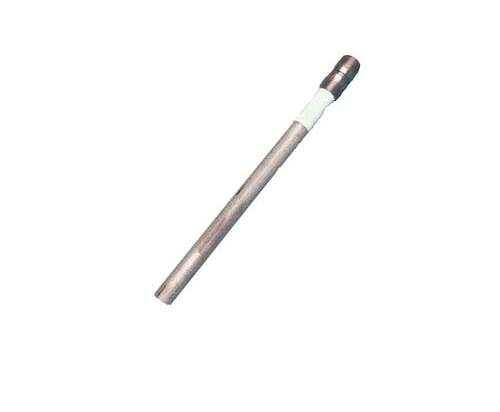
Genuine Raritan replacement magnesium anode for the 1700 Series marine water heater. The sacrificial anode corrodes preferentially to protect the glass-lined steel tank and fittings, while neutralising acids in the water. Regular anode renewal is the single most effective, lowest-cost way to extend the service life of any marine calorifier.
How sacrificial protection works
Put two dissimilar metals in water and you have a galvanic cell — the less noble metal corrodes first. The magnesium anode is deliberately the least noble metal in the tank, so it is consumed instead of the steel tank and fittings. On the 1700 Series’ glass-lined tank this matters even more: the anode protects the small areas where the glass lining is inevitably chipped or has pinholes — exactly where a bare tank would begin to rust. It also helps neutralise acids in the water.
Reading wear & when to replace
The anode only works while metal remains and it stays in firm electrical contact with the tank. Inspect it every 6–12 months and replace it once it has worn below 3/8" (9.5 mm) diameter, or is heavily pitted and crumbling. A fully consumed anode offers no protection — from that point the tank itself becomes the sacrificial metal, and glass-lined tank failures cannot be repaired. Because the Raritan anode is integral with the hot-water discharge fitting, renewing it also refreshes that fitting.
A note on ‘rotten egg’ smells
If the hot water develops a sulphur / rotten-egg odour, it is usually a reaction between the magnesium anode and naturally-occurring sulphate-reducing bacteria in the water — not a fault with the tank. Flushing and sanitising the tank normally clears it. If it persists, talk to us about anode options.
Select your size
- 23L (6 Gallon) models → part 1790610
- 45L & 76L (12 & 20 Gallon) models → part 1790010
Fitting
Isolate power, close the supply, relieve pressure and partially drain the tank before removing the old anode. Fit the new anode tight so it makes good electrical contact with the tank — an anode that is loose or isolated cannot protect it.


